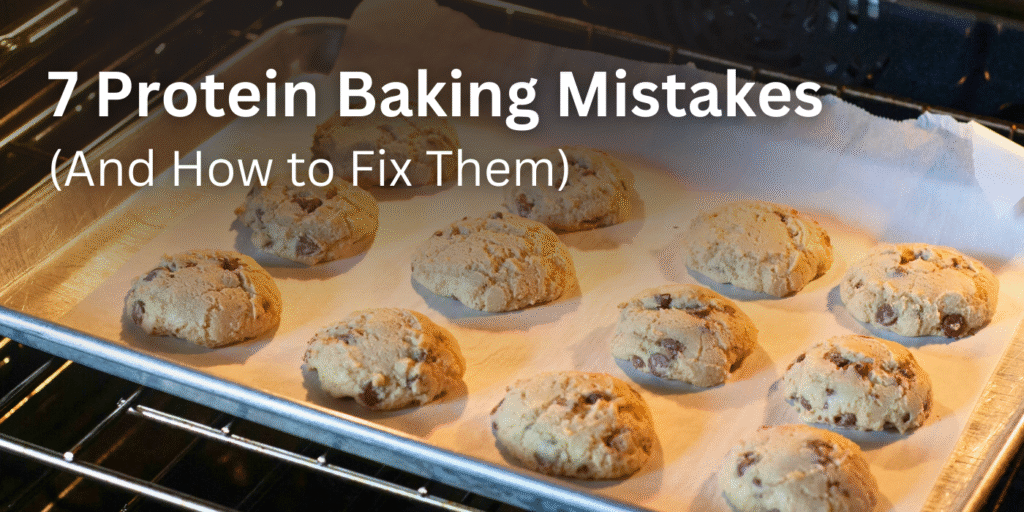
7 Protein Baking Mistakes (And How to Fix Them)
- Mistake #1: Using Too Much Protein Powder
- Mistake #2: Not Adding Enough Moisture
- Mistake #3: Skipping or Reducing Fat
- Mistake #4: Overbaking
- Mistake #5: Overmixing the Batter
- Mistake #6: Using the Wrong Protein Powder Type
- Mistake #7: Expecting Identical Results to Regular Baking
- Your Rescue Plan: What to Do When Things Go Wrong
- Moving Forward: Building Your Skills
- The Bottom Line: Mistakes Are Data
- References
Let’s be honest: your first attempt at protein baking probably didn’t go as planned. Maybe your muffins came out dry and crumbly, like eating sweetened sawdust. Maybe your cookies spread into one giant pancake across the baking sheet. Or maybe everything seemed fine until you bit into it and got that unmistakable chalky, “protein-y” taste that made you wonder if you’d accidentally baked a protein shake instead of a treat.
Here’s the thing—everyone’s first protein bake is rough. Everyone. The people who now post gorgeous protein brownies on Instagram? Their first batch was a disaster too. The difference between people who give up after one failed attempt and those who master protein baking is simple: they understood what went wrong and tried again with adjustments.
This guide walks you through the seven most common protein baking mistakes, explains why they happen, and—most importantly—tells you exactly how to fix them. By the end, you’ll know how to diagnose what went wrong with your batch and what to change next time. No more guessing, no more wasting expensive protein powder, just clear solutions.
As we covered in our complete guide to high protein baking, protein powder behaves fundamentally differently from flour. Understanding these differences is the key to avoiding these mistakes in the first place. But if you’ve already made them? You’re in the right place to fix them.
Mistake #1: Using Too Much Protein Powder
What happens: Your baked goods come out dense, dry, crumbly, and often with a gritty or chalky texture. They might fall apart when you try to remove them from the pan. The taste is overwhelmingly “protein-y” rather than like actual food.
Why it happens: Protein powder absorbs far more liquid than flour does—roughly 2-3 times as much. When you replace more than 1/3 of the flour with protein powder, you don’t have enough moisture to hydrate all that protein. You also lose the structural support that flour provides through starch gelatinization and gluten development (in wheat flour). The result is baked goods that are dry, dense, and crumbly all at once[1].
The temptation to maximize protein content is strong. You’re thinking: “If 1/3 substitution gives me 10g protein, wouldn’t 1/2 substitution give me 15g?” Technically yes, but you won’t want to eat it. And uneaten high-protein food provides zero protein.
The fix for next time:
- Replace no more than 1/3 of the flour with protein powder—and ideally start with just 1/4 if you’re new to protein baking
- If your recipe calls for 2 cups flour, use 1½ cups flour + ½ cup protein powder (that’s the 1/4 ratio) or at most 1⅓ cups flour + ⅔ cup protein powder (the maximum 1/3 ratio)
- Resist the urge to push higher—the texture penalty isn’t worth the extra few grams of protein
What to do with this batch:
- Crumble and use as a crunchy topping for yogurt parfaits or smoothie bowls
- Mix crumbs with nut butter and roll into protein balls
- Soak in milk or plant milk for a protein-packed “cereal”
- If it’s bread, use it for French toast (the egg mixture will add moisture)
Pro tip: If you absolutely must have more protein, add it through other ingredients (extra eggs, Greek yogurt, cottage cheese, nut butter) rather than pushing the protein powder ratio too high.
Mistake #2: Not Adding Enough Moisture
What happens: Your baked goods are dry—not crumbly like Mistake #1, but genuinely dry. They might look fine when they come out of the oven but become increasingly dry as they cool. They stick in your throat when you eat them and desperately need a glass of milk or water to wash them down.
Why it happens: Protein powder absorbs liquid continuously, even after baking. A batter that seems adequately moist when you mix it can yield dry baked goods because the protein has absorbed available moisture during and after baking[2]. This is especially true with whey protein isolate and casein, which are very absorbent.
Many people add a tablespoon or two of extra milk and think that’s sufficient. It’s not. You need substantial additional wet ingredients—we’re talking 1/4 to 1/2 cup per 1/2 cup of protein powder used.
The fix for next time:
- Add 1/4 to 1/2 cup extra wet ingredients for every 1/2 cup of protein powder you use
- Best moisture compensators:
- Greek yogurt (full-fat or 2%): 1/3 to 1/2 cup—adds protein too
- Mashed banana: 1/4 to 1/3 cup—adds natural sweetness
- Applesauce: 1/4 to 1/2 cup—neutral flavor
- Pumpkin puree: 1/4 to 1/3 cup—works especially well with chocolate
- Additional eggs or egg whites: 1 extra egg or 2 egg whites
- Don’t just add water—you need ingredients with fat or binding properties
- Use full-fat dairy, not fat-free (fat helps retain moisture)
What to do with this batch:
- Serve with a generous spread of nut butter, jam, or frosting
- Cut into cubes and use in bread pudding (soak in egg-milk mixture)
- Crumble and layer in parfaits with lots of yogurt
- For muffins or cupcakes, inject with a simple syrup or cream filling
Pro tip: Your batter should look wetter than you think it needs to be. Protein powder will continue absorbing moisture as it bakes and cools, so what seems “just right” in the bowl will be too dry in the finished product.
Mistake #3: Skipping or Reducing Fat
What happens: Your baked goods are dry (sensing a theme?) but also lack richness and flavor. They might also have a tough, rubbery texture instead of tender. Cookies don’t spread and stay in thick pucks.
Why it happens: Fat serves multiple critical functions in baking. It tenderizes by coating flour proteins and preventing gluten development. It adds moisture that doesn’t evaporate during baking. It carries flavor. It creates that melt-in-your-mouth texture we love[3].
Many people see protein baking as a “healthy” swap and eliminate or drastically reduce fat to cut calories. This is a mistake. Protein baked goods need fat more than regular baked goods do because protein powder already makes things drier and denser. Without adequate fat, you end up with something that’s technically high-protein but unpleasant to eat.
The fix for next time:
- Don’t eliminate fat from your recipe—keep at least the amount the original recipe calls for
- If anything, add a little more: 1-2 extra tablespoons of oil or melted butter
- Good fat sources for protein baking:
- Coconut oil or avocado oil: Neutral flavor, adds moisture
- Butter: Rich flavor, creamy texture
- Nut butters (peanut, almond, cashew): Add fat plus extra protein
- Full-fat Greek yogurt: Provides fat plus moisture and protein
- For cookies specifically, don’t reduce butter below 1/4 cup for a batch
- Oil keeps baked goods moister than butter (liquid fat vs solid fat)
What to do with this batch:
- Brush with melted butter immediately when they come out of the oven
- Serve with whipped cream, ice cream, or custard
- Drizzle with a glaze or icing
- For cookies, sandwich two together with nut butter or frosting
Pro tip: If you’re concerned about calories, remember that a slightly higher-fat protein muffin that you actually enjoy eating is better than a dry, fat-free one that sits in your fridge until you throw it away.
Mistake #4: Overbaking
What happens: The edges are dark brown or even burned, the tops are hard, and the texture is dry throughout. Even if you added plenty of moisture and fat, everything seems overdone.
Why it happens: Protein powder cooks faster than flour because of the Maillard reaction—the chemical reaction between amino acids and sugars that creates browning[4]. This same reaction is why meat browns when cooked. With protein powder in your batter, this reaction happens more quickly and at lower temperatures than in regular baked goods.
Additionally, protein coagulates (solidifies) as it heats, creating structure faster than starch gelatinization does. This means your baked goods set up and start drying out sooner than you expect.
Most people use the same temperature and timing as the original recipe. This guarantees overbaking with protein powder.
The fix for next time:
- Lower your oven temperature by 25°F (about 15°C)
- If recipe says 375°F → Use 350°F
- If recipe says 350°F → Use 325°F
- Reduce baking time by 3-5 minutes from the original recipe
- Start checking for doneness 5 minutes earlier than you think you should
- Use the toothpick test: It should come out with a few moist crumbs—not wet batter, but not completely clean either
- Remember: Protein baked goods continue cooking after you remove them from the oven, so it’s better to slightly underbake than overbake
What to do with this batch:
- If just the edges are overbaked, cut them off and enjoy the centers
- Soak in milk, coffee, or tea before eating (like biscotti)
- Blend into protein shake “crumbles” to add texture
- Process into fine crumbs and use as a base for no-bake desserts
Pro tip: If you’re baking something for more than 20 minutes (like bread or large cakes), tent aluminum foil loosely over the top halfway through to prevent the surface from over-browning while the center finishes.
Mistake #5: Overmixing the Batter
What happens: Your baked goods are tough, rubbery, or chewy instead of tender. They might also be dense but in a different way from Mistake #1—more gummy than crumbly.
Why it happens: When you mix flour with liquid, gluten proteins (in wheat flour) begin forming networks. The more you mix, the stronger these networks become. In bread, this is good—you want chewy texture. In muffins, cookies, and cakes, this is bad—you want tender texture[5].
Protein powder doesn’t form gluten, but overmixing still causes problems. Vigorous mixing breaks air bubbles, making baked goods dense. It also develops whatever gluten exists in the remaining flour more than you want. Finally, overmixing can make protein powder seize up and become gummy.
The fix for next time:
- Mix your wet ingredients and dry ingredients separately first, then combine
- When adding wet to dry, mix just until no dry streaks remain—some small lumps are fine
- Use a folding motion with a spatula rather than vigorous stirring or an electric mixer
- Count your folds: Aim for 20-30 gentle folds, then stop even if you see small lumps
- Add protein powder last when mixing dry ingredients (some people even stir it into the batter at the very end)
- For cookies, stop mixing as soon as the dough comes together
What to do with this batch:
- Not much you can do to reverse rubbery texture
- Slice thin and toast to make them crispy (works for quick breads)
- Use as a base for trifles or layered desserts where texture matters less
- Crumble and mix into yogurt or cottage cheese
Pro tip: Resist the urge to make the batter perfectly smooth. In protein baking, a lumpy batter yields better results than a silky smooth one.
Mistake #6: Using the Wrong Protein Powder Type
What happens: The flavor is off—earthy, bitter, or just “weird.” Or the texture is wrong—too gritty, too fluffy, or unexpectedly dense. Or both.
Why it happens: Different protein powders behave differently in baking. Whey protein creates a fine, cake-like texture but browns very quickly. Casein is extremely absorbent and creates moist, dense results. Pea protein has an earthy taste that clashes with delicate flavors. Rice protein creates a grainier texture. Soy protein behaves similarly to pea but with a nuttier taste.
Using unflavored protein powder in a delicate recipe (like vanilla cupcakes) lets the protein taste dominate. Using chocolate protein powder in a recipe that needs neutral flavor (like lemon poppy seed muffins) creates flavor clashes. Using whey protein isolate (very pure, very absorbent) when a recipe was tested with whey concentrate (less pure, less absorbent) throws off moisture balance.
The fix for next time:
- Match protein powder type to recipe style:
- Whey protein concentrate: Most versatile—muffins, pancakes, waffles, cakes
- Whey isolate: Very pure; needs even more moisture—use in recipes with naturally high moisture
- Casein or whey-casein blends: Super absorbent—best in no-bake items or very moist recipes
- Pea protein: Strong earthy taste—use with chocolate, peanut butter, banana, spices
- Rice protein: Grainy texture—good for cookies where slight crumbliness is fine
- Match flavor to recipe:
- Chocolate recipes → Chocolate or unflavored protein
- Strong flavors (peanut butter, banana, spice) → Vanilla or unflavored protein
- Delicate flavors → Vanilla protein, never unflavored
- If using unflavored protein, add extra vanilla extract (double the amount)
What to do with this batch:
- Mask taste with strong toppings: frosting, chocolate sauce, nut butter
- If too earthy, serve with coffee or strong tea
- Crumble and mix with chocolate chips or dried fruit
- Sometimes “fixing” means repurposing: blend into smoothies where flavor is easily masked
Pro tip: Buy small containers of different protein types to test before committing to a large tub. What works in shakes doesn’t always work in baking.
Mistake #7: Expecting Identical Results to Regular Baking
What happens: Your cookies are flatter and more cake-like than traditional cookies. Your muffins are denser than bakery muffins. Your pancakes are thicker and less fluffy. You followed the recipe perfectly, but the texture just isn’t the same.
Why it happens: This isn’t really a mistake—it’s a misalignment of expectations. Protein baked goods will never be identical to traditional versions because you’ve fundamentally changed the ingredient composition. Protein powder doesn’t create gluten networks. It doesn’t gelatinize like starch. It absorbs moisture differently. It cooks differently[6].
Expecting protein muffins to have the light, airy texture of bakery muffins sets you up for disappointment. They’ll be denser—that’s just physics. Expecting protein cookies to be crispy like Mrs. Fields will leave you frustrated. They’ll be softer and more cake-like—that’s how protein powder works.
The fix for next time:
- Adjust your expectations: Protein baked goods are a different category of food, not inferior versions of traditional baked goods
- Focus on what they do well: Protein content, satiety, nutrition, the ability to enjoy baked goods while meeting your health goals
- Appreciate the trade-offs: A denser muffin that keeps you full for four hours is arguably better than a light, fluffy one that leaves you hungry in an hour
- Choose recipes designed for protein powder rather than trying to convert every traditional recipe—some things just don’t convert well
- Compare to other protein baked goods, not to non-protein versions
What “success” looks like:
- Muffins: Dense but moist, substantial but not heavy
- Cookies: Soft, cake-like texture, not crispy
- Pancakes: Thick, hearty, filling—more like flapjacks than crepes
- Brownies: Very fudgy and dense (this actually works in your favor)
- Bread: Dense crumb, hearty texture—more like artisan bread than Wonder Bread
What to do right now:
- Embrace what you made instead of comparing it to an idealized version
- Adjust serving suggestions: Dense muffins work great sliced and toasted
- Change context: Call them “protein cakes” instead of muffins if that helps mentally
- Focus on how they make you feel: satiated, energized, proud that you made something nutritious
Pro tip: The more you make protein baked goods, the more you’ll develop an appreciation for their unique texture. Many people eventually prefer the denser, more substantial texture because it feels more satisfying.
Your Rescue Plan: What to Do When Things Go Wrong
Despite your best efforts, sometimes you’ll pull something out of the oven and immediately know it’s not right. Here’s your emergency triage guide:
If it’s TOO DRY:
- Immediate: Brush with simple syrup (equal parts sugar and water, heated until sugar dissolves)
- Within an hour: Wrap tightly in plastic wrap while still slightly warm to trap moisture
- Storage: Keep in an airtight container with a slice of bread (the bread will dry out; your baked goods will absorb that moisture)
- Serving: Always serve with beverages and spreads
If it’s TOO DENSE:
- Not much you can do for this batch, but:
- Slice thin and serve toasted
- Use in layered desserts where density isn’t a problem
- Crumble and use as mix-ins
- Next time: Reduce protein powder ratio, add more leavening
If it TASTES WEIRD:
- Frost, glaze, or drizzle with strong flavors (chocolate, coffee, maple)
- Serve with whipped cream or ice cream
- Soak in flavored liquids (coffee, milk, juice)
- Next time: Choose better protein powder flavor match
If it FELL APART:
- You have “rustic” crumbles—own it
- Mix with yogurt for parfaits
- Blend into smoothies
- Press into a pan with nut butter to make bars
- Next time: Add more binding agents (eggs, flour)
If TEXTURE IS WRONG:
- Cookies too soft: Refrigerate or freeze (they firm up)
- Cookies too hard: Store with apple slice to soften
- Rubbery: Slice thin and crisp in oven at 300°F
- Next time: Adjust mixing technique and moisture
Moving Forward: Building Your Skills
Now that you know what can go wrong and how to fix it, you’re equipped to improve with every batch. Here’s how to approach your next attempts:
For Your Next Bake:
- Choose a simple, forgiving recipe (banana bread, chocolate muffins)
- Use 1/4 protein substitution, not 1/3
- Add plenty of moisture compensation
- Lower temp by 25°F and set timer for 5 minutes less than recipe states
- Mix gently—count your folds
- Check for doneness early
- Take detailed notes
Keep a Baking Journal: Document each attempt:
- Recipe and source
- Protein powder brand and type
- Exact measurements used
- Oven temperature and actual baking time
- Result (texture, taste, appearance)
- What you’d change next time
After 5-6 attempts, patterns will emerge. You’ll learn that your oven runs hot, or that your protein powder needs extra moisture, or that you prefer slightly overbaked to slightly underbaked. This knowledge is invaluable.
Don’t Give Up After One Failure: Seriously. Even experienced bakers have protein baking failures. The difference is they shrug, make adjustments, and try again. Your fifth batch will be dramatically better than your first. Your tenth will be better than your fifth.
Celebrate Small Wins: Your protein muffins don’t have to be Instagram-perfect to be a success. If they taste good, meet your nutrition goals, and you’d willingly eat them again, that’s a win. Progress, not perfection.
The Bottom Line: Mistakes Are Data
Every failed batch of protein baked goods teaches you something. Dry muffins teach you that you need more moisture. Dense cookies teach you that you used too much protein powder. Rubbery pancakes teach you to mix less vigorously.
The seven mistakes in this guide aren’t failures—they’re learning experiences. Everyone who’s good at protein baking now has made every single one of these mistakes at least once. The key is understanding why they happened and how to prevent them.
Take what you’ve learned here, apply it to your next attempt, and remember: even an imperfect high-protein muffin is better nutritionally than skipping breakfast or eating something that doesn’t support your goals.
Your next batch is going to be better. You’ve got this.
For more guidance on protein baking fundamentals, check out our complete guide to high protein baking. For detailed substitution ratios and moisture calculations, see our step-by-step conversion guide. And for the science behind why protein behaves the way it does, read our article on protein and heat.
References
[1] A Sweet Pea Chef. (2024). Protein Powder as a Flour Substitute. https://www.asweetpeachef.com/protein-powder-as-a-flour-substitute/
[2] Matt’s Fit Chef. (2023). Baking with Protein Powder instead of Flour – The Ultimate Guide. https://mattsfitchef.com/baking-with-protein-powder-instead-of-flour/
[3] King Arthur Baking. (2023). The role of fat in baking. https://www.kingarthurbaking.com/blog/2023/01/09/the-role-of-fat-in-baking
[4] McGee, H. (2004). On Food and Cooking: The Science and Lore of the Kitchen. Scribner.
[5] Cook’s Illustrated. (2021). The Science of Mixing. America’s Test Kitchen.
[6] Avatar Nutrition. (2025). Ultimate Guide: Baking With Protein Powder For Beginners. https://www.avatarnutrition.com/blog/nutrition-info/baking-with-protein-powder/