This simple guide explains what protein is, what it does in the body, where it comes from, how much you need, and how to think about protein in everyday eating.

In this article
Why are we talking about protein?
Protein seems to be everywhere these days.
You see it in protein shakes and bars, on food labels, in recipes, and all over conversations about eating well. It is often talked about alongside muscle, workouts, weight loss, or products promising to help you get “more protein.”
But before we talk about how much protein you need or which foods contain it, there is a more basic question worth answering:

What exactly is protein, and why does your body need it?
Protein is a nutrient your body uses every day. It provides the amino acids your body needs to build and maintain its own proteins, which are involved in everything from the structure of tissues to enzymes, transport, signaling, and immune function.
So protein isn’t just a gym nutrient, and it isn’t synonymous with protein powder. It’s something your body needs, whether or not you exercise, count macros, or buy foods labeled “high protein.”
The good news is that understanding protein doesn’t have to mean turning your diet into a numbers game.
Let’s start with the basics: what protein actually is.
What Is Protein?
At its simplest, protein is a nutrient found in food, made up of smaller building blocks called amino acids.
When you eat protein, your body breaks the proteins in food down into amino acids during digestion. Those amino acids can then be absorbed and used by your body to make and maintain its own proteins.
And this is an important distinction: the protein you eat is not simply added to your muscles or other tissues as-is.
Your body breaks it down first, then uses the resulting amino acids as raw materials for its own needs.
Proteins are made from amino acids.
Think of amino acids as the individual pieces that make up proteins.
There are 20 amino acids that are commonly used to build proteins in the human body. Your body can make some of them on its own. Others, known as essential amino acids, must come from the foods you eat because your body cannot make enough of them.
Different proteins contain different combinations and proportions of amino acids. That is one reason why different protein-containing foods are not nutritionally identical, even though they all provide protein.
We don’t need to memorize all the amino acids to understand how protein works. The useful idea to keep in mind is simply this:
Protein provides the amino acids your body needs to make its own proteins.
Why does your body need it to make its own proteins?
Because proteins are part of almost every aspect of how your body is built and works.
Your body uses proteins as structural components of tissues, but proteins also make up enzymes that help chemical reactions happen, participate in signaling, transport substances, and support immune functions.
So when we say that protein is a “building block,” that doesn’t mean it is only about building muscle.
Protein is one of the raw materials your body uses to build and maintain many different things.
That is why protein is an essential nutrient—not because it belongs in a gym routine, but because your body needs amino acids every day.
That basic process is the foundation for everything else we’ll talk about when it comes to protein.
What Does Protein Do in the Body?
Now that we know what protein is, the next question is probably the most useful one:
What does your body actually use protein for? The short answer is: a lot.
Protein isn’t responsible for just one job. Your body makes thousands of different proteins, and they play different roles in keeping your body built, maintained, and functioning.
Protein has many different roles in the body, from helping maintain tissues to supporting enzymes, signaling, transport, and immune function.
If you want to look more closely at what those different proteins actually do, our guide to
What Does Protein Do in the Body?
explores these roles in more detail.
Protein helps build and maintain your body
Some proteins are part of the structure of your body.
They help make up tissues such as muscle, skin, connective tissue, and other parts of the body. Your body is constantly maintaining and renewing its tissues, so it needs a regular supply of amino acids to make new proteins.
This is one reason protein is often described as a building block.
But building is only part of the story.
Proteins also help your body do its work
Many proteins have functional jobs rather than simply providing structure.
Some proteins act as enzymes, helping the chemical reactions that keep your body working. Others are involved in transport, helping move substances around the body. Some participate in signaling and communication, while others are part of the body’s immune defenses.
So when you eat protein, you’re not just giving your body material to build muscle.
You’re providing amino acids that can be used to make the many different proteins your body needs for both structure and function.
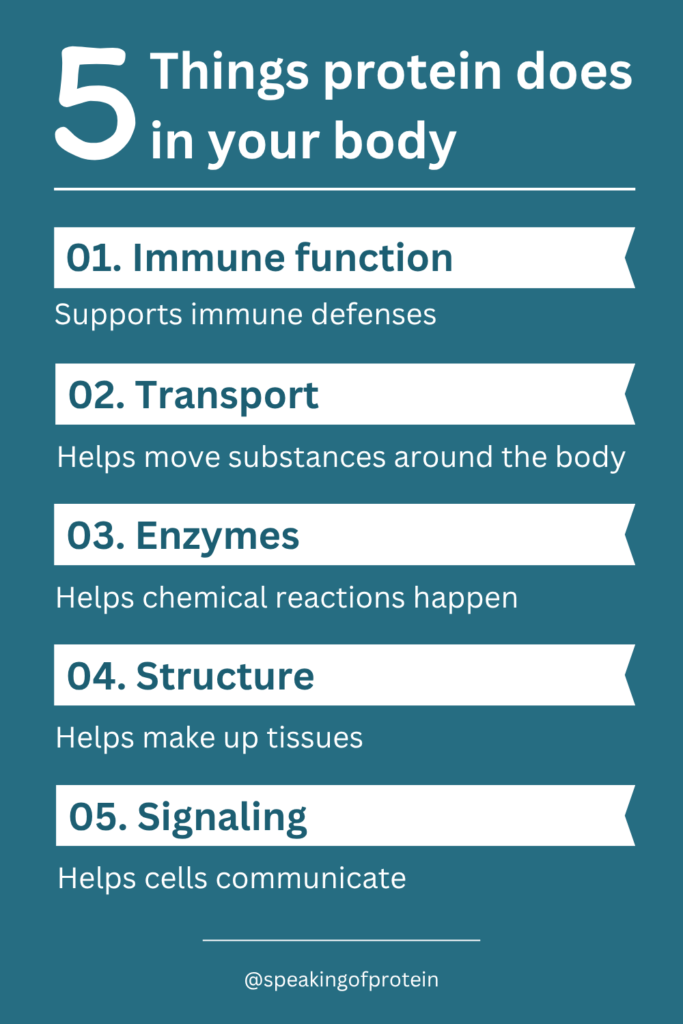
This is why protein matters beyond muscle
Muscle is an important place where protein is used, but it is only one part of the picture.
Your body needs protein whether you’re trying to build muscle or not. You don’t have to exercise, lift weights, or follow a particular diet for protein to have a role in your body.
And that’s an important idea to keep in mind as we go through everything else in this guide:
Protein isn’t a “gym nutrient.”
It’s a nutrient your body uses every day.
The question isn’t simply whether protein is good for you. Your body already needs it.
The more useful questions about protein are:
- Where can you get it?
- How can you make it part of the way you already eat?
- How much do you need?
- Do you need protein powder to reach the daily needs?
Those are the questions we’ll explore next.
Where Does Protein Come From?
Once you know that your body needs protein, a very practical question follows:
Where do we actually get it? The answer is probably more familiar than you think.
Protein is already present in many everyday foods, yet marketing often makes it seem like something you need to get from specially formulated shakes, bars, or products labeled “high protein.”
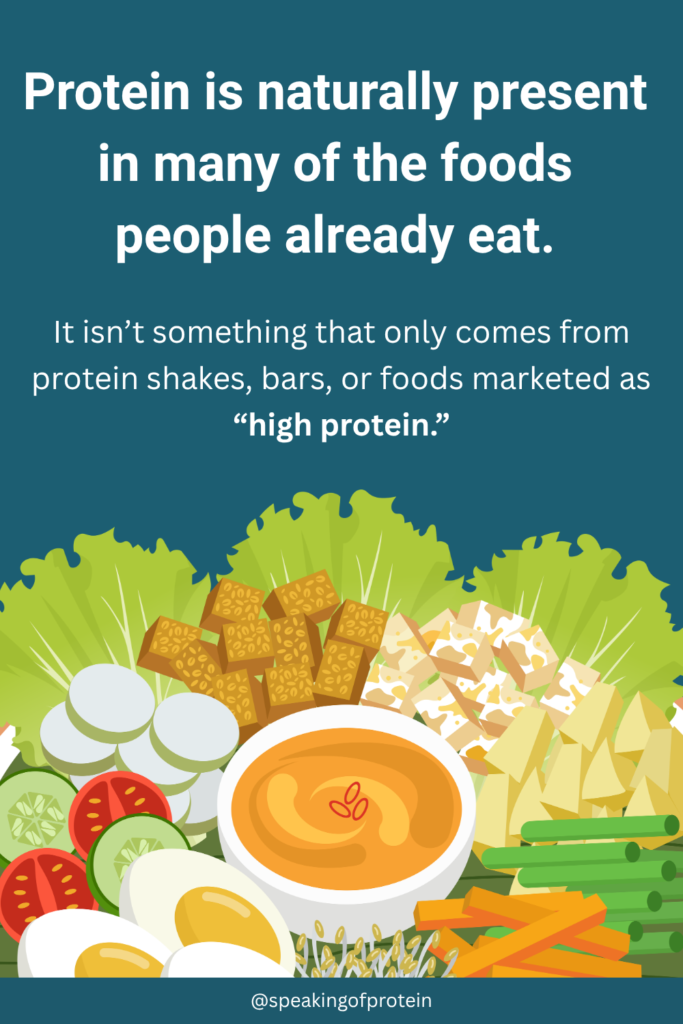
In reality, protein-rich foods are not limited to products designed and marketed around it.
Protein comes from both animal and plant foods
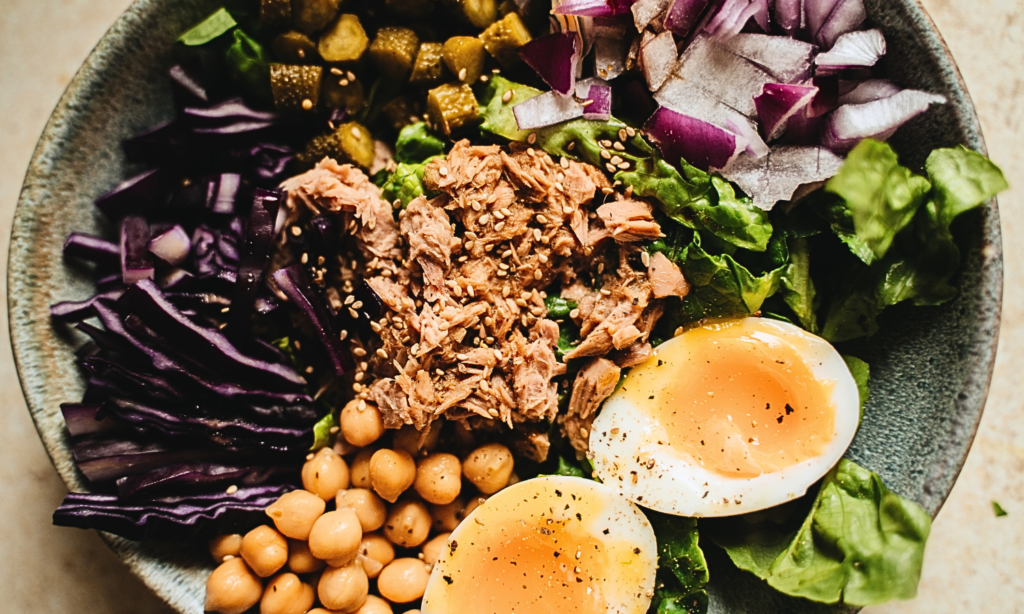
Common sources of protein include:
- Dairy foods such as milk, yogurt, and cheese
- Eggs
- Fish and seafood
- Meat and poultry
- Beans, peas, and lentils
- Soy foods such as tofu and edamame
- Nuts and seeds
- Some grains and other plant foods also contribute protein.
The amount varies considerably from one food to another, but the important point is that protein is spread across many different foods and food groups.
You don’t have to eat meat to get protein. You don’t have to eat animal foods at all. And you don’t have to rely on specially formulated products.
Protein can come from a mix of animal and plant foods.
Protein is already in your everyday foods
When protein is discussed in terms of shakes, bars, and “high-protein” products, it’s easy to think of it as something you have to add to your diet. The way we talk about protein can make food seem more complicated than it is.
A food doesn’t have to be high in protein to contribute protein. Milk contains protein. So do oats, bread, pasta, rice, nuts, seeds, and beans, many of which may already be in your kitchen.
Fruits and vegetables contain some protein too, although most aren’t concentrated sources of it. That doesn’t make them unimportant. They contribute many other nutrients, and WHO recommends a varied diet that includes foods such as fruits, vegetables, legumes, nuts, and whole grains.
That’s one reason it’s more useful to think about protein as part of your overall diet, rather than dividing foods into “protein foods” and “everything else.”
Protein is one part of a food’s nutritional picture, not the whole picture.
Some foods provide more, and each brings something different
Of course, foods differ in how much protein they provide. A serving of Greek yogurt contributes more than a serving of berries. Lentils provide considerably more than most fruits. So the amount matters, but context matters too.
Different protein-containing foods also come with different nutritional companions:
- Beans and lentils provide protein along with fiber.
- Nuts and seeds provide it along with fats and other nutrients.
- Dairy foods provide it along with nutrients such as calcium.
So choosing a protein source isn’t only about asking: “How much protein does this food have?”.
It’s also worth asking: “What else does this food bring to the table?”
Instead of trying to find the single “best” protein source, you can build variety into the way you eat and let different foods contribute in different ways.
The goal isn’t to make every food a high-protein food. It’s to understand where protein is coming from across the foods you regularly eat.
What about fruits and vegetables?
Yes, fruits and vegetables contain protein. But most aren’t particularly concentrated sources of it. Even guava, the fruit with the most protein among common varieties, has only about 2.5 grams per 100 grams.
That doesn’t make them unimportant or mean you should choose foods based on protein content alone. Fruits and vegetables contribute many other nutrients and are an important part of a healthy eating pattern. WHO recommends a varied diet that includes foods such as fruits, vegetables, legumes, nuts, and whole grains.
The same principle applies in the other direction: a food can be a useful source of protein without being the only thing worth considering about that food.
Protein is one part of a food’s nutritional picture—not the entire picture.
Look at the whole meal
Instead of thinking that every meal needs a specially chosen “protein source,” it can be more useful to look at the meal as a whole.
Imagine a bowl of oatmeal made with milk and topped with nuts and seeds.
You could look at the oats and say, “They’re not a high-protein food.” But that misses the bigger picture.
The oats, milk, nuts, and seeds all contribute different nutrients, including protein. Together, they create a meal that provides protein without requiring a scoop of protein powder to make it “count.”
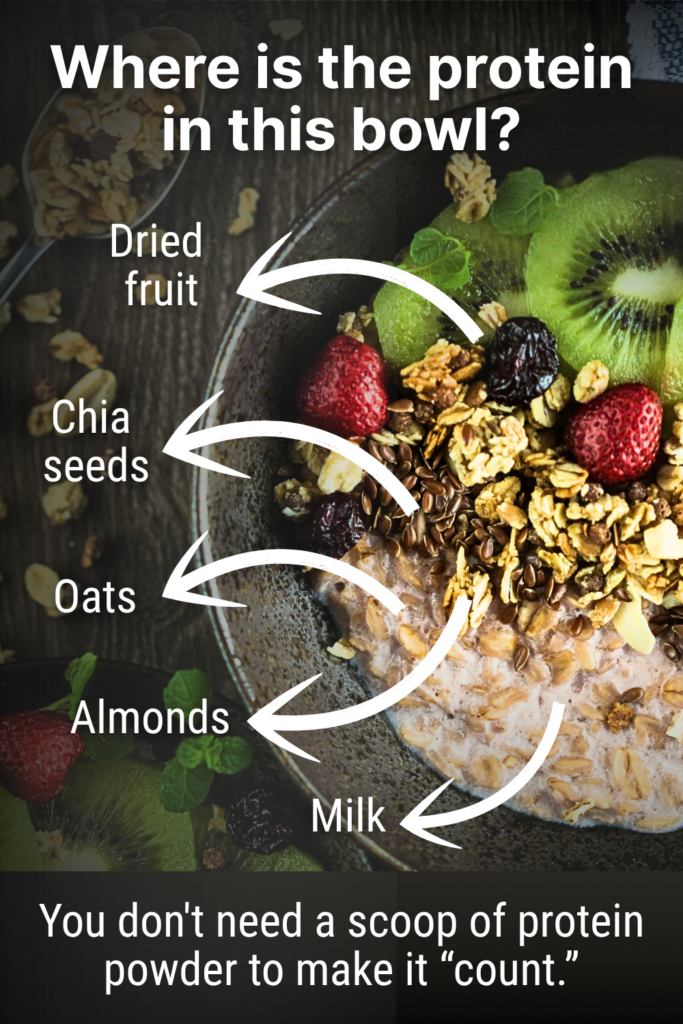
This is the kind of thinking we want to encourage here.
Instead of asking: “Which foods are high in protein?”
sometimes a better question is: “Where is the protein already coming from in the foods I eat?”
Once you start asking that question, protein becomes less about finding special foods and more about understanding the food that’s already on your plate.
That brings us to a distinction we’ll come back to throughout this site:
Protein is a nutrient. Protein-containing foods are foods that provide it.
How Much Protein Do We Need?
Once you know why protein matters, it’s natural to ask:
How much do I actually need?
This is where things can get confusing, because there isn’t one number that applies identically to every person.
The U.S. and Canada share the same Recommended Dietary Allowance (RDA) for protein: 0.8 grams per kilogram of body weight per day, set by the Institute of Medicine (now the National Academy of Medicine) in a joint 2005 report.
For example, a 70-kilogram adult would get:
70 kg × 0.8 g/kg = 56 grams of protein per day
But it’s important to understand what that number actually means.
The 0.8 g/kg number isn’t a personal prescription
The RDA is a reference number designed to cover almost every healthy person in a group — not a personal target.
Individual requirements can vary.
Life stage and physiological circumstances can affect protein needs, which is why reference values differ for situations such as pregnancy and lactation.
There are also situations in which protein needs may need to be considered differently, such as certain health conditions or periods of illness. Those situations are beyond the scope of a general guide like this one.
So 0.8 g/kg is useful as a reference point, but it isn’t a magic number.
Does more protein mean better?
Not necessarily.
Protein is essential, but that doesn’t mean that more is automatically better.
It’s easy to fall into the idea that if some protein is important, adding more must always be an improvement. But nutrition doesn’t work quite that simply.
The goal isn’t to see how much protein you can fit into your diet.
The goal is to get enough.
And “enough” depends on the person and the circumstances.
Why don’t we just give everyone one number?
Because nutritional requirements aren’t identical from person to person.
The recommendations we use are based on population-level evidence and are designed to cover the needs of most healthy people. They are useful reference values, but they are not measurements of your individual requirement.
Researchers also continue to study how best to determine protein requirements. Different scientific methods can produce different estimates, which is one reason you may come across recommendations that don’t all agree.
That doesn’t mean current recommendations are meaningless.
It means we should be careful about presenting any single number as if it were a universal rule.
For most people, understanding the concept of adequate protein is more useful than constantly trying to maximize protein intake.
And once you understand that, the next question becomes more interesting:
What happens when you don’t get enough?
What Happens If You Don’t Get Enough Protein?
We’ve talked about why protein matters and what “enough” can mean.
But what happens when you consistently don’t get enough?
The answer depends on how much protein is missing, for how long, and what else is happening with your overall nutrition and health.
A small difference between your usual intake and a reference value doesn’t automatically mean that something is wrong.
Your body can adapt—but it still needs protein
Your body is constantly making and breaking down proteins.
When protein intake is inadequate, the body has ways of adapting. But there are limits to how much it can compensate.
When low protein intake goes on for a long time, the body can struggle to keep up normal processes and tissues.
Severe protein deficiency can contribute to serious nutritional problems, including loss of body tissue and impaired growth in children. It can also occur alongside broader forms of undernutrition or particular health circumstances.
That is very different from simply eating fewer grams of protein than someone recommends online.
Protein deficiency is not the same as “I could eat more protein”
This distinction is important.
There is a big difference between not getting enough protein to meet your body’s needs and simply eating less protein than someone on the internet recommends.
You might see claims that tiredness, hair loss, cravings, or other everyday symptoms are signs that you need more protein.
But symptoms like these can have many different causes. They are not a reliable way to diagnose protein deficiency on your own.
Actual protein deficiency is a nutritional condition—not simply a feeling that you haven’t eaten enough protein today.
So should you worry about getting enough?
For most people, this isn’t about constantly wondering whether they’re deficient.
It’s about understanding that protein is an essential part of your diet and making room for protein-containing foods as part of your usual eating pattern.
You don’t need to turn every meal into a protein calculation. You also don’t need to wait until you have a problem before protein becomes something worth paying attention to.
The more useful approach to protein is somewhere in between:
Know why protein matters, understand what adequate inmteake means for you, and learn where protein naturally fits into the foods you alredy enjoy.
What About Protein Powder?
By now, you may be wondering about something that’s hard to miss when you start looking into protein:
What about protein powder?
Protein powders can make it seem as though getting enough protein requires a scoop, a shaker bottle, and a trip to the supplement aisle.
It doesn’t.
Do you need protein powder?
For most people, protein powder isn’t automatically necessary.
You can get protein from a wide variety of foods, including dairy, eggs, fish, meat, legumes, soy foods, nuts, and seeds.
But “not necessary” doesn’t mean “never useful.”
There are situations where a protein powder or protein-fortified food can be a convenient way to add protein to what you’re already eating.
Maybe you’re short on time. Maybe you don’t particularly enjoy cooking. Maybe you have difficulty getting enough protein from the foods you normally eat. Or maybe you simply like using protein powder as an ingredient in a smoothie, oatmeal, pancake, or baked recipe.
In those cases, convenience can be a perfectly valid reason for using it.
Food first doesn’t mean protein powder is bad
We don’t need to think of this as an “either/or.”
Whole and minimally processed foods can provide protein along with other nutrients, and they can form the foundation of your diet. Protein powders can be useful tools when they make getting protein easier or more practical.
The important question isn’t: “Is protein powder good or bad?”
A more useful question is: “Does this product make sense for the way I eat?”
That’s a question we’ll return to later, because once you start looking at protein powders, the choices can become surprisingly complicated. For now, remember the simple distinction:
Protein powder is just one possible way to get protein.
And there is one more part of the story that’s useful to understand: what actually happens to protein after you eat it.
What Happens to Protein After You Eat It?
We’ve established that protein provides your body with amino acids. But how does that actually happen?
What happens to that egg, yogurt, lentils, chicken, tofu, or protein powder once you eat it?
It goes through digestion.
We’ll walk through the basics here. If you want the step-by-step version — digestion, absorption, and where those amino acids actually go — that’s exactly what What Happens When You Eat Protein? covers.
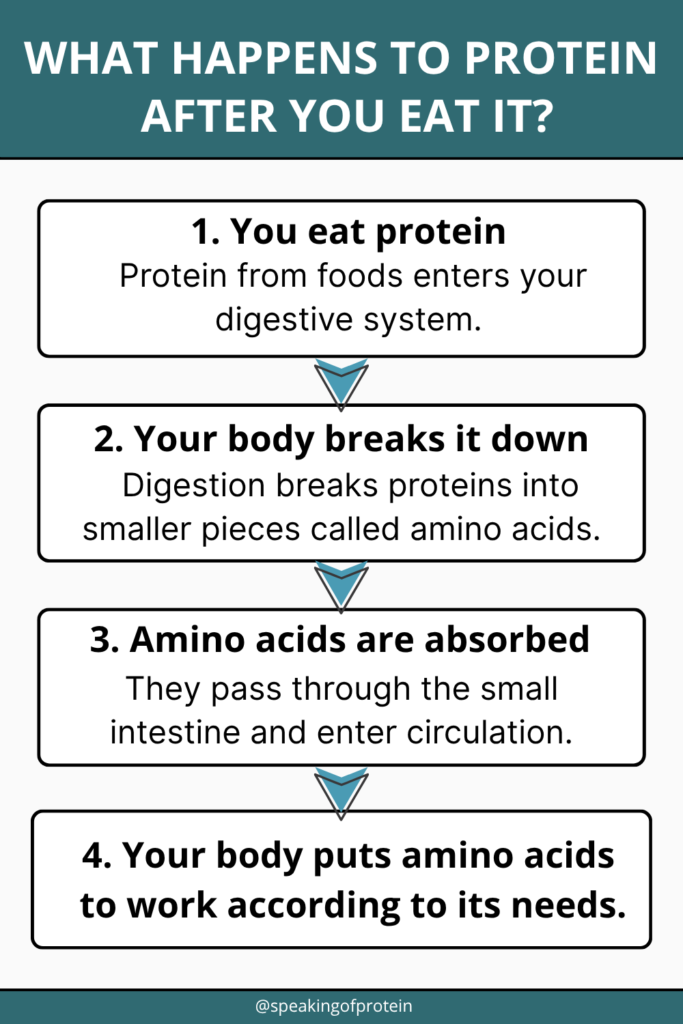
First, your body breaks protein down
The proteins in food are large molecules made up of chains of amino acids.
Your digestive system breaks those proteins down into smaller components, including amino acids, that your body can absorb and use. This process involves digestive enzymes in the stomach and small intestine.
So the protein you eat doesn’t simply travel through your body and become “your protein.”
Your body takes it apart first.
Then, your body puts those building blocks to work
Once amino acids are available, your body can use them to make proteins and for other metabolic processes.
This is why it’s useful to think of dietary protein as providing raw materials, rather than as something that has a single destination.
Your body doesn’t have a dedicated storage tank where it keeps extra dietary protein waiting for later.
Instead, amino acids are continually being used and processed as part of normal metabolism.
Protein is part of a continuous process
Your body is constantly making and breaking down proteins.
Dietary protein supplies amino acids that become part of this ongoing process of maintaining and making proteins throughout the body.
That means the protein you eat today isn’t assigned to one particular job.
Your body uses the amino acids available to it according to its needs.
And this brings together much of what we’ve covered so far:
You eat protein → digestion breaks it down → amino acids become available → your body uses them to make and maintain the proteins it needs.
That’s the basic journey.
And understanding that journey makes one thing clear:
Protein isn’t a single substance with a single job. It’s part of a constantly changing system that helps your body build, maintain, and function.
What Does This Mean for the Way You Eat?
After all of this, you might be wondering:
What am I actually supposed to do with this information?
The answer doesn’t have to be complicated.
You don’t need to turn every meal into a calculation, replace the foods you enjoy, or start buying everything labeled “high protein.”
A good place to start is simply by noticing where protein is already present in the way you eat.
Maybe it’s the yogurt you have at breakfast. The eggs in your weekend pancakes. The lentils in a soup. The milk in your oatmeal. The nuts and seeds you add to a snack. The tofu, fish, meat, or beans that make up part of a meal.
Some foods provide more protein than others. And depending on your needs, you may want to pay more attention to how much protein you’re getting overall.
But you don’t have to make protein the whole point of eating.
Start with the foods you already know
One of the easiest ways to make protein feel less complicated is to start with familiar foods rather than with numbers.
- How much protein is in an egg?
- What about oats?
- Does flour contain protein?
- How much do beans or lentils contribute?
- What about milk, yogurt, nuts, seeds, fruits, or vegetables?
These questions are often more useful in everyday life than simply asking which food has the most protein.
Because once you understand what individual foods contribute, you can start seeing how protein fits across meals and throughout the day.
Now, if you’re wondering what all those proteins actually do once they’re in your body, that’s the question we explore next in:
Frequently Asked Questions:
This is where to go next
Protein Sources is where we can explore protein-containing foods individually:
- what they contribute,
- how much protein they contain,
- what else they bring nutritionally,
- and—when useful—how they can fit into the kinds of meals and recipes you already enjoy.
The goal isn’t to rank every food from “best” to “worst.”
It’s to help you understand your options.
Because there isn’t one perfect protein food for everyone, just as there isn’t one perfect way to eat.
The more you understand the foods available to you, the easier it becomes to make choices that work for your own table.
And that’s really what understanding protein is for:
Not making eating more complicated, but making it easier to make sense of the food you already eat.
Sources & Further Reading
Health Canada. Protein. https://www.canada.ca/en/health-canada/services/nutrients/protein.html
Health Canada. Dietary Reference Intakes. https://www.canada.ca/en/health-canada/services/food-nutrition/healthy-eating/dietary-reference-intakes.html
Health Canada. Eat Protein Foods. https://www.canada.ca/en/health-canada/services/food-guide/explore/healthy-eating-recommendations/eat-variety/eat-proteins.html
Institute of Medicine (Food and Nutrition Board). (2005). Dietary Reference Intakes for Energy, Carbohydrate, Fiber, Fat, Fatty Acids, Cholesterol, Protein, and Amino Acids. National Academies Press. https://www.nationalacademies.org/projects/HMD-FNB-18-P-119/publication/10490
National Institutes of Health / NIDDK . Your Digestive System & How It Works. https://www.niddk.nih.gov/health-information/digestive-diseases/digestive-system-how-it-works
World Health Organization. Healthy Diet. https://www.who.int/news-room/fact-sheets/detail/healthy-diet